
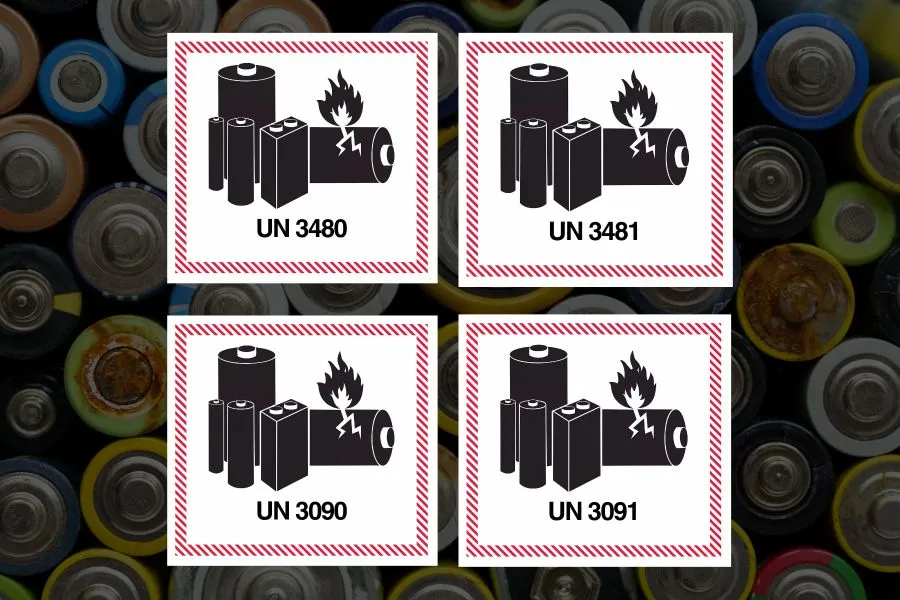
Battery shipping labels and markings help identify batteries during transportation. This guide is specifically about the labels and markings used on battery shipments, not the specification label printed directly on a battery by its manufacturer.
Depending on the shipment, you may see identification numbers such as UN3480, UN3481, UN3090, or UN3091. These numbers help identify the battery chemistry and whether the batteries are being shipped alone, packed with equipment, or installed inside equipment.
Additional marks or hazard labels may also be required depending on the battery type and how the shipment is being transported. If you have batteries that have reached the end of use, Battery Recycling and Solutions provides battery recycling services for a wide range of battery types and quantities.
What Are Battery Shipping Labels?
The phrase “battery label” is often used broadly, but not every marking on a battery shipment serves the same purpose.
Some markings identify the material being transported. Others communicate that a package contains lithium batteries or identify a regulated hazard class.
UN Identification Numbers
UN identification numbers are four digit numbers used to identify regulated materials during transportation.
For lithium battery shipments, common examples include:
- UN3480
- UN3481
- UN3090
- UN3091
The correct number depends primarily on the battery chemistry and how the batteries are packaged in relation to the equipment they power.
Lithium Battery Marks
Certain qualifying lithium battery shipments may display a lithium battery mark containing the applicable UN identification number.
The mark helps carriers and handlers recognize that the package contains lithium batteries and identifies the relevant battery classification.
Hazard Labels
Certain fully regulated lithium battery shipments may also require a Class 9 lithium battery hazard label.
A UN identification number, lithium battery mark, and Class 9 hazard label are related, but they are not the same thing. The markings required for a specific shipment depend on the batteries and the applicable transportation requirements.
Different Types of Battery Shipping Labels
The four main lithium battery UN classifications become much easier to understand once you separate them by battery chemistry and shipping configuration.
UN3480: Lithium Ion Batteries Shipped Alone
What it means: UN3480 identifies lithium ion batteries shipped without the equipment they are designed to power.
Battery type: Rechargeable lithium ion batteries, including lithium polymer batteries.
Shipping configuration: The batteries are transported as standalone items.
Common examples include:
- Replacement laptop batteries
- Power tool batteries
- Loose lithium ion cells
- Rechargeable battery packs
- Power banks
- Spare rechargeable batteries
If a lithium ion battery is traveling by itself rather than with its equipment, UN3480 is generally the relevant classification.
UN3481: Lithium Ion Batteries With Equipment
What it means: UN3481 identifies lithium ion batteries that are either installed inside equipment or packed in the same shipment as the equipment they are intended to power.
Battery type: Rechargeable lithium ion batteries, including lithium polymer batteries.
Shipping configuration: The batteries are traveling with equipment.
There are two main UN3481 configurations.
Lithium Ion Batteries Contained in Equipment
“Contained in equipment” means the battery is physically installed inside the device it powers.
Examples include:
- Laptop with its battery installed
- Mobile phone
- Cordless power tool
- Tablet
- Medical device with an installed rechargeable battery
The battery travels as part of the equipment.
Lithium Ion Batteries Packed With Equipment
“Packed with equipment” means the battery is not installed inside the device but is packaged in the same shipment as the equipment it is intended to power.
For example, a camera packaged with a separate rechargeable lithium ion battery may fall under UN3481.
The simplest way to remember it is this: UN3481 means the lithium ion battery is traveling with its equipment rather than as a standalone battery shipment.
UN3090: Lithium Metal Batteries Shipped Alone
What it means: UN3090 identifies lithium metal or lithium alloy batteries shipped without equipment.
Battery type: Primarily non rechargeable lithium metal batteries.
Shipping configuration: The batteries are transported as standalone items.
Common examples include:
- Loose lithium metal cells
- Lithium coin cells
- Replacement lithium metal batteries
- Primary lithium batteries
- Bulk lithium metal cells
UN3090 is essentially the lithium metal counterpart to UN3480. Both apply to standalone battery shipments, but the battery chemistry is different.
UN3091: Lithium Metal Batteries With Equipment
What it means: UN3091 identifies lithium metal or lithium alloy batteries that are either installed inside equipment or packed with the equipment they are intended to power.
Battery type: Lithium metal or lithium alloy batteries.
Shipping configuration: The batteries are traveling with equipment.
Common examples may include:
- Watches
- Medical devices
- Tracking devices
- Cameras
- Electronic measuring equipment
There are two main configurations.
Lithium Metal Batteries Contained in Equipment
The lithium metal battery is physically installed inside the product it powers.
A watch shipped with its lithium coin cell installed is a straightforward example.
Lithium Metal Batteries Packed With Equipment
The battery is separate from the device but packaged in the same shipment as the equipment it is intended to power.
For example, a camera shipped with separate lithium metal batteries intended for that camera may fall under UN3091.
UN3091 is the lithium metal counterpart to UN3481. Both involve batteries traveling with equipment, but UN3091 applies to lithium metal batteries rather than lithium ion batteries.
Battery Label Comparison Chart
The four main lithium battery UN classifications are easiest to understand when you compare the battery chemistry with how the battery is being shipped.
| Label | Battery Type | Shipping Configuration | Simple Example |
| UN3480 | Lithium ion | Shipped alone | Replacement laptop battery |
| UN3481 | Lithium ion | With equipment | Laptop with battery |
| UN3090 | Lithium metal | Shipped alone | Box of lithium coin cells |
| UN3091 | Lithium metal | With equipment | Watch containing lithium battery |
The simplest framework to remember is:
UN3480 and UN3481 = lithium ion batteries
UN3090 and UN3091 = lithium metal batteries
Numbers ending in 0 = batteries shipped alone
Numbers ending in 1 = batteries traveling with equipment
That basic distinction makes the four classifications much easier to identify.
Frequently Asked Questions About Battery Labels
What Do Battery UN Numbers Mean?
Battery UN numbers identify specific regulated battery types and shipping configurations during transportation.
For lithium batteries, the number helps indicate both the battery chemistry and whether the battery is traveling by itself or with equipment.
What is the Difference Between UN3480 and UN3481?
UN3480 applies to lithium ion batteries shipped by themselves.
UN3481 applies to lithium ion batteries that are either packed with equipment or installed inside the equipment they power.
What is the Difference Between UN3090 and UN3091?
UN3090 applies to lithium metal batteries shipped by themselves.
UN3091 applies to lithium metal batteries packed with or contained in equipment.
What is the Difference Between UN3480 and UN3090?
Both classifications apply to batteries shipped without equipment, but the chemistry is different.
UN3480 applies to lithium ion batteries.
UN3090 applies to lithium metal batteries.
Is a Lithium Battery Mark the Same as a Class 9 Label?
No.
A lithium battery mark identifies a qualifying package containing lithium batteries and may display the applicable UN number.
A Class 9 lithium battery hazard label is a separate hazard label used for certain regulated shipments. The two should not be treated as interchangeable.
Does Putting the Correct Battery Label on a Box Make It Compliant?
No.
The correct label or marking is only one part of preparing a battery shipment.
The batteries may also need to meet applicable requirements for classification, packaging, testing, documentation, transportation method, and carrier acceptance.
Conclusion: Understanding Battery Shipping Labels
UN3480 and UN3481 identify lithium ion batteries, while UN3090 and UN3091 identify lithium metal batteries. The difference between the classifications ending in 0 and 1 comes down primarily to whether the batteries are traveling alone or with equipment.
Identifying the correct UN number is an important first step, but it does not replace the other transportation requirements that may apply. If you have batteries that have reached the end of use, Battery Recycling and Solutions provides battery recycling services for a wide range of battery chemistries and quantities.